26 June 2026
A Key Visual Illustration; and a glimpse into Africa
Online gaming and gaming communities have been a connective tissue that branches the globe, bringing together people from many different backgrounds, histories, and beliefs. The illustration made by a team of staff and students from the Academy of Digital Arts in collaboration with PUBG Mobile South Africa visualises that gathering.
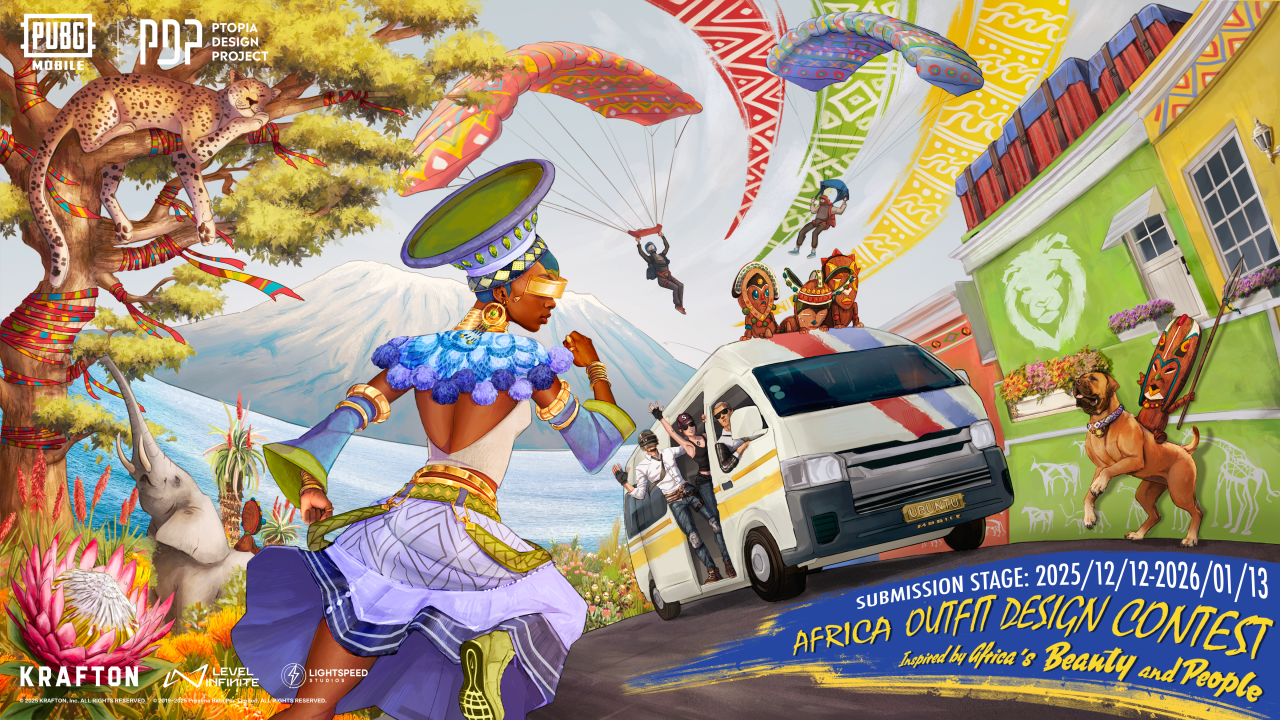
Online gaming and gaming communities have been a connective tissue that branches the globe, bringing together people from many different backgrounds, histories, and beliefs. The illustration made by a team of staff and students from the Academy of Digital Arts in collaboration with PUBG Mobile South Africa visualises that gathering. The custom-designed main character runs to invite some classic characters from the game to the African themed design competition, while more people parachute in against the backdrop of a crisp ocean, and Kilimanjaro keeping a watchful eye on the horizon. It’s a bright illustration with vibrancy to mirror Africa and its people.
A common occurrence for African online gamers are infamous questions like: “Do you have lions walking around in your streets?” or “do you have electricity?”. In the true spirit of African humour, these questions are met with responses like “yes, I ride my pet lion to school” or “I use a giraffe’s neck toget a signal that connects me to the game servers” or "yes... we have electricity when Eskom allows it.”
As funny as these questions are to those fortunate enough to have electricity and not lions – it makes me think of ‘The Danger of a Single Story’, a fantastic TED talk hosted by Chimamanda Ngozi Adichie in 2009. Adichie grew up in Nigeria; she speaks about how, when she moved to an American university, her roommate was surprised that she could speak English, use a stove and that she listened to Mariah Carey instead of “tribal music”. Her roommate had a single story of what it meant to be African.
I would highly recommend anyone to spend the 20 minutes it would take to watch the talk here for fuller context. But the point I would like to highlight is that Africa does not just have a single story. The story that is represented in the media – that of beautiful landscapes, wild animals, and poor people fighting in wars and waiting for a foreigner to donate to an Instagram add is not our only truth. Because once the media has defined you to be one single thing (poor, uneducated and waiting for a saviour), you are not allowed to be something more than that. This echoes in the impactful quote from the trailer of the game ‘Relooted’ by Joburg-based studio Nyamkop.
“Youdon’t get to see Africa in the future very often.It’s almost like Africa is not allowed to dream and be hopeful of what the future looks like ”
So, when we were approached by the commissions team of PUBG Mobile Africa to design a key visual that represents Africa – it was immediately apparent to us the challenge that lay ahead. Several major things needed to be considered, but the main one was that Africa is a continent with 54 countries, home to upwards of three thousand distinctly different cultures, each with their own unique languages and people. A single illustration cannot tell all these stories. And what we didn’t want to do was put all these stories into a blender and serve the ‘Africa soup’ single story that international media has come to expect. Instead, we limited it down and decided to tell a few specific stories that were close the hearts of the artists on the design team. The context of these stories are what I want to recount in this article.
THE STORY OF THE LION IN THE STREETS
I know I said we don’t have lions in the streets. But Africa’s breathtaking nature and wildlife is a defining feature of the continent for a good reason. It is utterly stunning and without comparison, in my biased opinion, and African people have an ingrained connection with it.
This illustration tells the story of a Marula tree – found widely across the continent; an elephant reaches for one of the sweet marula fruits while a leopard (not a lion) rests in the branches. Beneath the tree, plants from the beautiful Cape floral kingdom, including proteas, candelabra aloes and fynbos bloom in all their glory.
The story of Africa’s natural beauty is one often told. In fact, it is one of the main attractions that brings international tourists flooding to the continent. Africa is beautiful and, to internationals, it is an inviting holiday destination. The flip side of this story, however, is that Africa is often dressed up and commodified to be sold to international tourists without benefit to any locals and nationals. We love to share the natural beauty and wildlife of this continent; experience it in all its glory. But we hope for a tourism industry that is more conscious of the price of these experiences; one that support locals, considers the impact of short-term rentals, and makes sure that some of those international currencies make it to those who need it most.
THE STORY OF THE MATATU
There is no real way to explain the mixed emotions of being cut off by a taxi with a bumper sticker that says, “sorry boss” or “control your envy”. Taxis have a reputation for hilarious and overt disregard for road rules, driving on sidewalks, stopping in the middle of the road, hooting their horns and generally causing a bit of chaos wherever they go.
The Kenyan matatu and South African Quantum minibus taxi were the main inspirations behind the vehicle represented in this illustration. In this case, PUBGM characters take up the spots that would usually be inhabited by the taxi driver and his “gaatjie” - the colloquial term for the assistant that helps passengers, shouts the taxi’s route and gives you a thumbs-up out the window when you let them merge ahead of you. In the spirit of the smart quips and bumper stickers, the word “Ubuntu” replaces the license plate. Ubuntu is interpreted slightly differently in different languages, but essentially represents the concept that “I am because we are” - the belief in a universal bond of sharing that connects all humanity, or “the profound sense that we are human only through the humanity of others”, as Nelson Mandela put it.
In the spirit of ubuntu we recognize that, despite the frustrations of sharing a road with vehicles pulling dangerous stunts to jump three cars ahead in traffic, these ubiquitous, privately owned vehicles form an essential part of Africa’s public transport in lieu of reliable transport infrastructure. This illustration nods at this ecosystem of transport vehicles that is so essential to the African economy that they would cripple productivity if they do not tirelessly deliver workers to their place of work. My advice – just let them merge.
THE STORY OF THE COLOURFUL BO-KAAP
Many Instagram-worthy photoshoots have taken place using the brightly coloured houses lining the streets of the Bo-Kaap in Cape Town as a backdrop. The Bo-Kaap contains the largest concentration of pre-1850 architecture in South Africa and is a truly beautiful sight compared to the glass skyscrapers and bland minimalism of the city bowl architecture.
Most of the residents of the Bo-Kaap are Cape Malays, which stems from the neighbourhood's history as rental housing for slaves from around 1795. Throughout its history the inhabitants faced forced relocations and segregation. Some say that the homes were painted so brightly once residents were allowed to buy their homes as a sign of individualism and pride. Since then, the Bo-Kaap has blossomed into a vibrant and closely knit district that hosts community- gardens, markets and carnivals. Yet till this day the commodification and gentrification of the inner-city drives many of the Bo-Kaap's residents to relocate outside the city, taking much of the neighbourhoods' history with them.
The two stories of the colourful Bo-Kaap are of a neighbourhood that deserves to be seen as more than a tour destination and photo backdrop. Ultimately, no matter how colourful the houses are painted, it’s the people that make the area bright.
THE STORY OF OUR MAIN CHARACTER AND HER COMPANIONS
The main character of our illustration is a Zulu inspired lady. She wears an izicolo hat and long skirt that signals her as married, and her intricate shawl is inspired by the beautiful beadwork made by Zulu women. The Zulu culture is one of many proud cultural groups that remain strong and vibrant through adversity on the African continent. To the outside world these heritages are often perceived to be stuck in the past, outdated; with few opportunities to be represented in the modern day. You see cultural attire on a character in a film and immediately assume ‘this film is set in the 1600’s.’
The intention with our illustration was for our leading lady to be a symbol of strength, but also a symbol of the modern day – and the future. She cannot be mistaken for someone from times past, and neither should African cultures be. The companion characters with her wear one of the most universal aspects of African culture. The ceremonial masks that inspired these companions have some presence in most African countries and are historically used to contact and embody guiding forces like ancestors and spirits. Many of these original artifacts were ferried away during the colonisation period and are till this day kept in museums overseas. In this illustration, they are characterized to show that Africa’s history and culture is here, now, and not locked away as a part of ancient history.
These are her two stories, the story of someone who knows who she is and her history, as well as someone who is undeniably unafraid to dream of what the future holds. And to some extent, this is the story that echoes through the whole illustration. Africa, it’s people and it’s beauty are things to be admired without commodification, protected without being put behind a pane of glass, and celebrated without being perceived as an act or a show.
In closing - may the Marula bear fruit for another year. May you travel your roads with patience. May you wear the hat that tells your story with pride, and may you paint your house whatever colour you want to.
This article was written by a human. And this illustration was made by 4 very talented human artists. We thank PUBGM Africa for supporting locals, and for supporting artists.